
LEARN and EARN!
Get your RV Technician Certification in as little as 5 weeks!
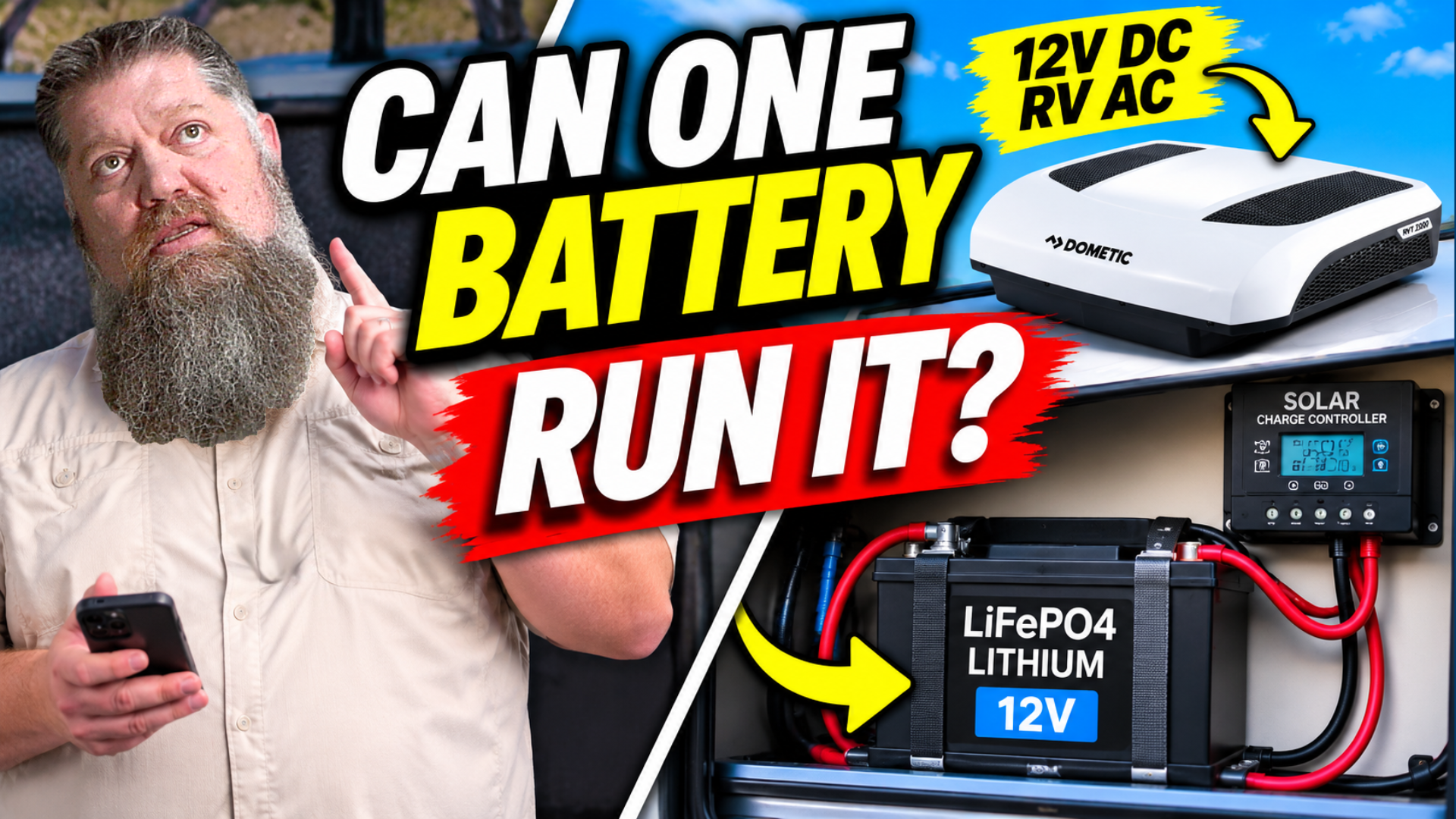
Thinking about replacing your RV’s traditional rooftop air conditioner with a newer 12V DC model? Some of these units advertise significantly lower power consumption, making them an attractive option for RV owners looking to spend more time off grid.
But before making the switch, there’s an important question to answer.
Can one lithium battery power your RV’s air conditioner and everything else in your travel trailer?
In this week’s Todd’s Two Minute Tech Tip Tuesday from the National RV Training Academy (NRVTA), we’re answering a viewer’s questions about upgrading from AGM to lithium batteries, solar controller compatibility, and installing a 12V RV air conditioner.
The upgrade is possible, but choosing the right battery and wiring makes all the difference.
Why Does an RV AGM Battery Lose Charge During Storage?
A viewer with a 2023 Forest River Wildwood X Lite travel trailer noticed that his factory AGM battery gradually loses charge during storage, even with the main battery disconnect switches turned off.
His RV already has a 200 watt solar panel and a 30 amp solar charge controller, but the battery still loses power over time.
This is normal for lead acid batteries, including AGM and gel batteries.
Even when disconnected from the RV’s electrical system, these batteries naturally lose charge through a process called self discharge.
Turning off the battery disconnect switch can eliminate many of the RV’s electrical loads, but it won’t stop the battery’s natural chemical processes.
The best approach is to keep the battery properly maintained during storage.
If shore power is available, a compatible converter or battery charger can help maintain the battery. A properly configured solar charging system may also provide enough power to keep it charged.
If your RV is stored somewhere without electricity or adequate sunlight, removing the battery and maintaining it at home may be a better option.
Can You Replace an RV AGM Battery With Lithium?
Yes, an AGM battery can be replaced with a lithium battery, provided the RV’s electrical and charging systems are compatible.
Lithium batteries offer several advantages over traditional lead acid batteries, including greater usable capacity, lower weight, and the ability to deliver substantial current.
However, switching battery chemistry involves more than disconnecting the old battery and installing a new one.
The RV’s converter, solar charge controller, and other charging equipment must support the charging requirements of the new battery.
That brings us to the viewer’s next question.
Is the Go Power GP PWM30 Solar Controller Lithium Compatible?
The travel trailer is equipped with a Go Power GP PWM30 solar charge controller.
Fortunately, this controller supports multiple battery chemistry settings, including lithium on compatible versions.
The appropriate battery type can be selected through the controller’s mode settings.
Before installing a lithium battery, verify the controller’s exact model and available charging profiles. The selected charging settings should match the battery manufacturer’s specifications.
The solar controller is only one part of the charging system. The RV’s converter and any other charging sources should also be checked for lithium compatibility.
Can One Lithium Battery Run a 12V RV Air Conditioner?
Yes, a properly sized lithium battery can power a 12V RV air conditioner while also supplying the RV’s other electrical loads.
However, not every lithium battery is capable of handling that demand.
Some newer 12V rooftop air conditioners advertise power consumption around 200 to 500 watts under certain operating conditions.
At higher output, power consumption may approach 900 watts, depending on the air conditioner.
That additional electrical demand must be considered alongside everything else running in the RV.
Lights, water pumps, refrigerator controls, fans, and other 12V appliances all draw power from the same battery system.
If the battery cannot deliver enough current to support those combined loads, the system may shut down or fail to operate as intended.
A larger lithium battery or a properly configured battery bank may be necessary.
How Much Battery Power Does a 12V RV Air Conditioner Need?
Let’s look at the numbers.
A 12V air conditioner drawing 500 watts requires approximately 42 amps at a nominal 12 volts.
Increase that demand to 900 watts, and the current rises to approximately 75 amps.
These figures represent the air conditioner’s electrical demand alone.
Any additional appliances operating at the same time increase the total load on the battery.
For a system with substantial electrical demands, a battery capable of delivering 150 to 200 amps may be worth considering, depending on the equipment being used.
But current capability isn’t the only factor.
A battery’s maximum discharge current determines how much power it can deliver at once. Its usable capacity determines how long it can continue supplying that power.
For example, an air conditioner consuming 500 watts continuously for two hours uses approximately 1,000 watt hours of energy.
A larger battery provides more potential runtime, but actual performance depends on the battery’s usable capacity, voltage, other connected loads, and the air conditioner’s operating conditions.
Before choosing a battery, check its continuous discharge rating, battery management system limits, and usable energy capacity.
Why a 12V RV Air Conditioner Needs Different Wiring
Here’s where the installation becomes more complicated.
Most traditional RV rooftop air conditioners operate on 120V alternating current.
Their electrical wiring was designed for that voltage and the current requirements of the original equipment.
A 12V DC air conditioner operates at a much lower voltage.
To deliver the same amount of power at a lower voltage, the electrical system must carry more current.
That often means significantly larger cables.
You cannot assume the existing 120V air conditioner wiring is suitable for a new 12V DC unit.
A DC air conditioner may require a new cable run from the battery system to the rooftop unit.
Depending on the RV’s construction, routing those cables through walls, ceilings, and compartments can be one of the most challenging parts of the installation.
Proper cable sizing depends on the air conditioner’s maximum current draw, the distance between the battery and air conditioner, acceptable voltage drop, and the manufacturer’s installation requirements.
Appropriate circuit protection is also essential.
Simply replacing the rooftop air conditioner without addressing the electrical wiring can create serious problems.
Is a 12V RV Air Conditioner Upgrade Worth It?
A 12V DC air conditioner can be an appealing option for RV owners interested in off grid camping or reducing their dependence on shore power.
However, the air conditioner is only one part of the electrical system.
Before purchasing equipment, consider several important questions:
- Can your lithium battery supply enough current for the air conditioner and other appliances?
- Does the battery have enough usable capacity to provide the runtime you want?
- Can your existing solar system replace a meaningful amount of the energy being consumed?
- Is there a practical route for installing the larger DC cables?
- Does the new air conditioner require additional electrical protection or system modifications?
A 200 watt solar panel, for example, cannot continuously replace the energy consumed by an air conditioner drawing 500 watts or more. The battery must supply the difference, and the available runtime will depend on the system’s total energy capacity.
A successful upgrade requires looking at the entire electrical system rather than focusing on the air conditioner alone.
Learn RV Electrical and Solar Systems at NRVTA
Upgrading an RV battery or installing a new air conditioner becomes much easier when you understand how the electrical system works.
Battery chemistry, charging profiles, current demand, cable sizing, and electrical protection all play important roles in a properly designed installation.
At the National RV Training Academy in Athens, Texas, students receive hands-on training in RV electrical systems, solar power, batteries, diagnostics, and troubleshooting.
NRVTA’s RV Service Technician training helps students develop practical skills for diagnosing and repairing RV systems. These skills can also provide a foundation for those interested in starting their own mobile RV service businesses.
Watch this week’s Todd’s Two Minute Tech Tip Tuesday for more information about AGM battery storage, lithium upgrades, solar controller compatibility, and powering a 12V RV air conditioner.
Visit NRVTA.com to learn more about available training programs.


Get Registered Today!
Talk to a student advisor to learn more!