
LEARN and EARN!
Get your RV Technician Certification in as little as 5 weeks!
Modern RV electrical systems can support more equipment and longer periods away from shore power than many older systems. Lithium batteries, inverter-chargers, generators, solar equipment, and automatic transfer devices can give RV owners tremendous flexibility.
That flexibility also makes troubleshooting more complicated. A component’s advertised wattage or battery capacity does not necessarily tell you how the complete system will perform.
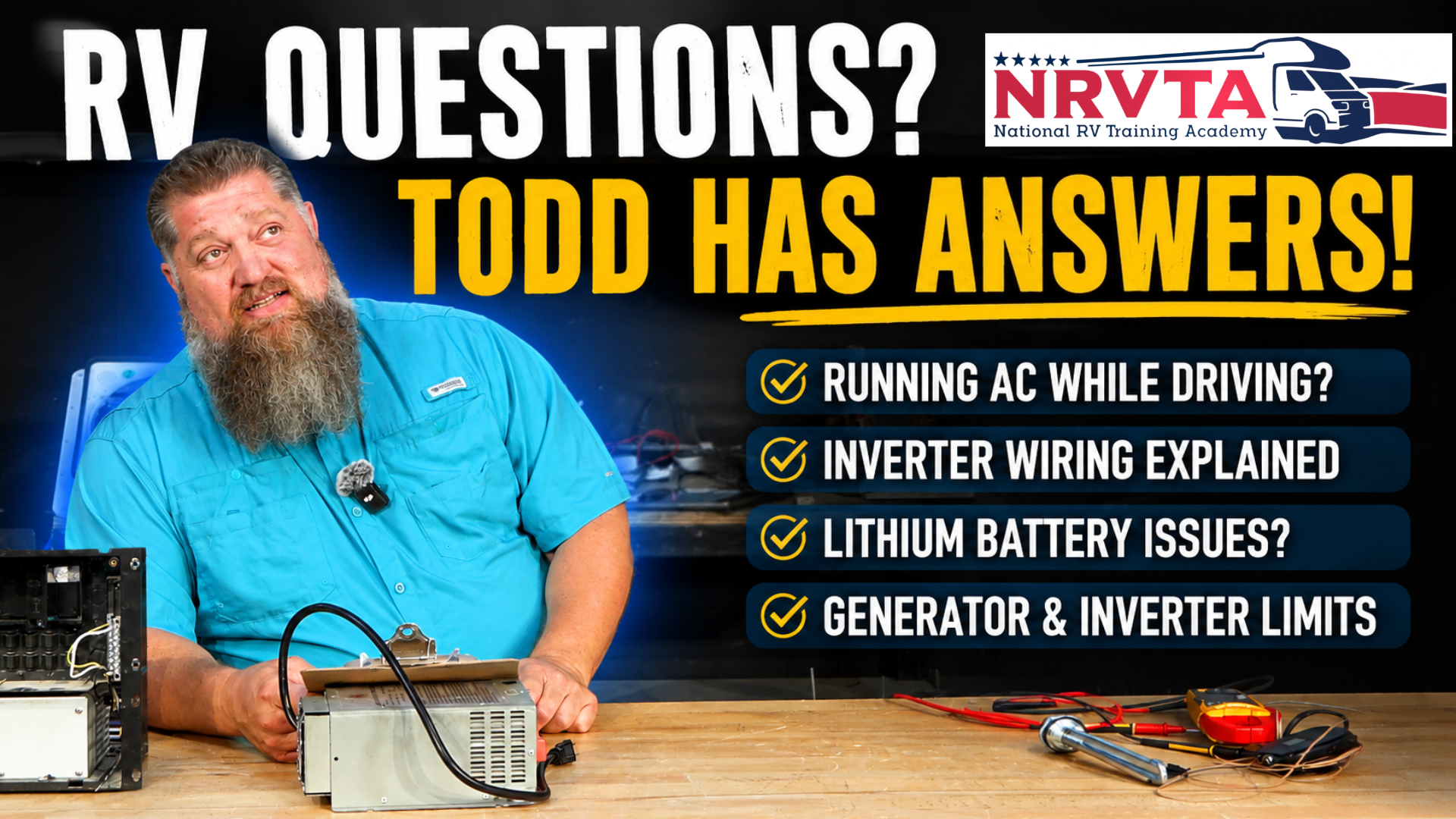
In this edition of Todd’s Two Minute Tech Tip Tuesday, Todd addresses four common RV electrical system questions involving air conditioners, inverter configurations, lithium batteries, and generator output. Here is a closer look at the answers, along with several important safety and system-design considerations.
Can You Run an RV Air Conditioner While Driving?
In many RVs, the air conditioner can operate while the vehicle is moving, provided it has a suitable source of 120-volt AC power and the equipment manufacturer permits mobile operation.
That power may come from:
- An onboard generator
- A properly sized inverter and battery bank
- An electrical system that combines batteries, alternator charging, and solar charging
Dometic notes that mobile air-conditioner operation is possible when an appropriate power system is installed. However, owners should still consult the manuals for their specific RV, air conditioner, inverter, generator, and battery system before operating the air conditioner on the road.
A 2,500-watt inverter and 400 amp-hour lithium battery bank may be capable of operating certain RV air conditioners, but those numbers alone do not guarantee successful operation. The system must also accommodate:
- The air conditioner’s continuous running load
- The compressor’s startup demand
- Other appliances operating from the inverter
- The inverter’s continuous and surge ratings
- The battery bank’s voltage and discharge limits
- The capacity of the battery cables, fuses, and disconnects
- The Battery Management System, or BMS
A soft-start device may reduce compressor startup demand, but it does not increase the inverter’s continuous capacity or the amount of energy stored in the batteries.
Fueling Safety Comes First
Starting the air conditioner shortly before arriving at a campsite can help cool the RV before setup. However, the air conditioner or generator should not be started while the RV is actively being fueled.
Cummins instructs operators to stop the generator before fueling the coach because generator operation can ignite flammable vapors. The safest approach is to complete fueling, move the RV away from the pump area, and then start the generator or air conditioner in an appropriate location.
Understanding Single-Leg Inverter Systems in a 50-Amp RV
A standard 50-amp RV electrical service has two 120-volt hot legs. Under normal campground service, those legs supply the two sides of the RV’s electrical distribution panel.
A 30-amp or smaller 120-volt source is different. When an approved adapter is used, the same 120-volt source may be supplied to both sides of the RV panel. Both sides can then operate 120-volt appliances, but the RV does not gain the full capacity of a 50-amp connection. It also does not have usable 240-volt power.
Some inverter-chargers are specifically designed to manage these different inputs. For example, Victron states that the MultiPlus-II 2x120V can accept either a 120/240-volt split-phase source or a single-phase 120-volt source. With a single-phase source, the unit accepts incoming power through L1 and supplies 120 volts to both sides of the output. True 240-volt power is available only when the input source provides split-phase 120/240-volt power.
Why One Installation Cannot Be Copied to Every RV
A configuration that works in one RV may be unsafe or ineffective in another. Important differences can include:
- Inverter model and continuous output rating
- Transfer-switch design
- Neutral and grounding configuration
- Circuit-breaker and fuse ratings
- Wire size
- Location of loads within the electrical panel
- Presence of 240-volt equipment
- Generator output configuration
- Input-current and PowerAssist settings
Pass-through capability is also different from inverter output. An inverter-charger may pass a substantial amount of shore or generator power to the RV while producing much less power when operating from batteries.
Adapters should never be used to bypass required circuit protection or create improvised power connections. Inverter and transfer-switch modifications should be designed and inspected by someone qualified to work on RV electrical systems.
Why Two Lithium Batteries May Not Share a Load Equally
Lithium batteries connected in parallel should generally contribute to the same battery-bank load. However, they may not supply exactly the same current at every moment.
Small differences can result from battery state of charge, temperature, internal resistance, cable resistance, or measurement accuracy. A large and persistent difference—such as one battery doing nearly all the work while another appears to remain full—deserves further investigation.
Possible causes include:
- Loose or improperly torqued terminals
- Different cable lengths or cable sizes
- A blown fuse or open disconnect
- Corroded or damaged connections
- Excessive voltage drop in one battery’s circuit
- A BMS that has disconnected a battery for protection
- Different battery capacities, ages, or states of charge
- An inaccurate battery monitor or app reading
Parallel-battery wiring should provide a comparable current path through each battery. Victron recommends connecting system cables diagonally across a parallel bank to help create equal current paths. Its wiring guidance also explains that poor parallel connections can cause one battery to carry more current than another.
Before servicing a lithium battery bank, shut down the appropriate power sources and follow the battery manufacturer’s procedures. Lithium systems can produce very high fault current, so cables, terminals, disconnects, and overcurrent protection must be handled carefully.
Why a 6,000-Watt Generator May Not Deliver 6,000 Watts to the Loads
A generator’s nameplate rating describes its overall output capability under specified conditions. It does not guarantee that every appliance connected through an inverter-charger can use that entire amount.
An RV equipped with a 6,000-watt generator may still experience an inverter trip near 2,800 watts for several reasons:
- The generator’s output may be divided between circuits.
- Only one generator circuit may be connected to the inverter input.
- The inverter may have a lower continuous output rating.
- The inverter’s AC input-current limit may be set too low.
- PowerAssist may be available only on one input leg.
- The load may be connected to an inverter-supported circuit rather than a direct pass-through circuit.
- Battery voltage may be dropping under load.
- High temperature may reduce inverter output.
- An air conditioner or other motor may create a brief startup surge.
For the Victron MultiPlus-II 2x120V, PowerControl and PowerAssist operate on the L1 input. When the unit receives single-phase 120-volt power, both output lines can supply 120-volt loads, but that arrangement does not create two independent sources of inverter capacity. The exact continuous output and overload limits depend on the specific inverter model and operating conditions.
Will an Autotransformer Increase the Available Wattage?
An autotransformer can change or balance how voltage is distributed in a properly engineered system, but it does not create additional electrical power.
Similarly, adding a second inverter may increase available inverter capacity only when the units, batteries, cabling, programming, transfer equipment, and distribution panel are designed to work together. Neither option should be treated as a simple plug-in solution.
Before replacing equipment, a technician should verify:
- The generator’s model, voltage, amperage, and circuit configuration
- The exact inverter model and continuous rating
- The inverter’s programmed input-current limit
- Which panel circuits are connected to each output
- Voltage and current measurements under load
- Battery voltage at the inverter terminals
- Cable voltage drop
- Transfer-switch operation
- Fault or overload history recorded by the inverter
Measurements are essential because the same symptom can result from an overloaded inverter, a wiring limitation, a configuration setting, low DC voltage, or a generator problem.
Troubleshoot the Complete RV Electrical System
These RV electrical system questions all lead to the same lesson: troubleshooting should focus on the complete power path rather than one component.
On the AC side, that path may include the generator or shore connection, transfer switch, inverter-charger, distribution panel, branch circuit, and appliance.
On the DC side, it may include the batteries, BMS, busbars, disconnects, fuses, cabling, charging equipment, and inverter.
Understanding how those components interact helps RV owners avoid unnecessary parts replacement and gives technicians a more reliable diagnostic process.
Build Practical RV Electrical Knowledge
RV owners who want to better understand their batteries, AC and DC systems, appliances, and basic troubleshooting can explore the Educated RV Owner training pathway.
Those interested in developing broader diagnostic and repair skills can review the RV Service Technician program. NRVTA’s published curriculum includes classroom and lab instruction involving RV electrical systems and other major RV components.
Training does not replace the need to follow manufacturer instructions or use a qualified professional for work beyond your experience. It can, however, help owners and aspiring technicians develop a more systematic approach to understanding and troubleshooting RV systems.
Sources
- Cummins Onan Operator Manual, generator fueling and electrical safety guidance.
- Victron Energy, MultiPlus-II 2x120V product description and technical specifications.
- Victron Energy, Lithium Smart Battery installation and parallel-bank wiring guidance.
- Dometic, guidance on operating an RV air conditioner while traveling.
- National RV Training Academy, Educated RV Owner and RV Service Technician program information.



Get Registered Today!
Talk to a student advisor to learn more!