LEARN and EARN!
Get your RV Technician Certification in as little as 5 weeks!
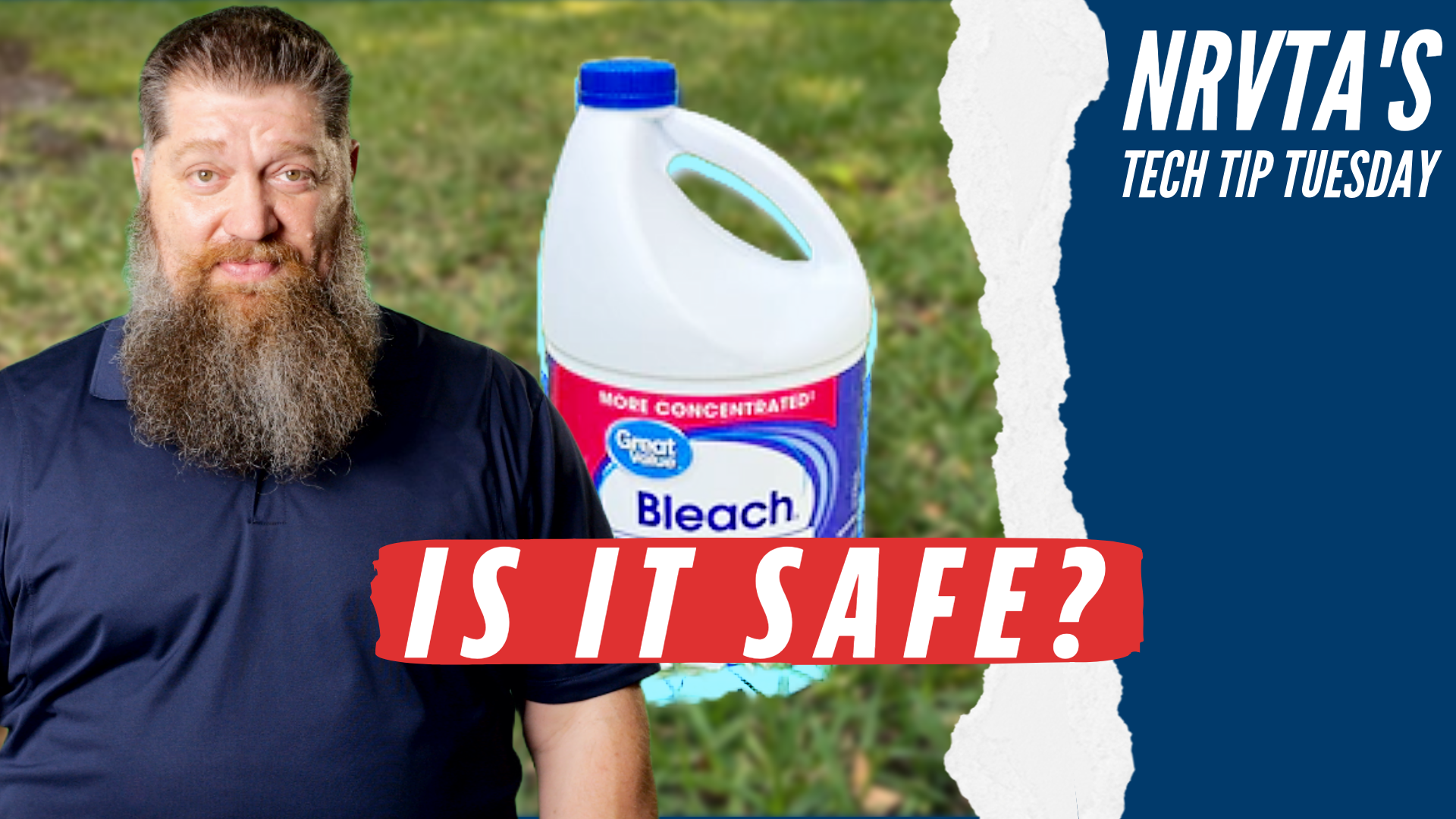
Is Bleach Safe for Sanitizing an RV Fresh Water System?
Welcome back to another Todd’s Two-Minute Tech Tip Tuesday from the National RV Training Academy.
Today, Todd is answering a question RV owners ask frequently:
Can you safely use bleach to sanitize an RV’s fresh water system?
The answer is generally yes—but only when bleach is permitted by your RV manufacturer and used according to the procedure in your owner’s manual.
Bleach Can Be Effective, but Proper Use Matters
Plain, unscented household chlorine bleach contains sodium hypochlorite, a disinfectant used in water-treatment and sanitizing applications. The CDC notes that regular household bleach commonly contains between 5% and 9% sodium hypochlorite. It also advises against using products such as splashless bleach when preparing disinfecting solutions.
Several RV manufacturers publish bleach-based procedures for sanitizing fresh water systems. However, that does not mean every bleach product, concentration, or procedure is appropriate for every RV.
The correct process may depend on:
- Your fresh water tank’s capacity
- The concentration listed on the bleach label
- Your RV’s plumbing configuration
- Whether water filters must be removed or bypassed
- Whether the water heater must be bypassed
- The concentration and contact time specified by the manufacturer
Your RV owner’s manual should be the primary source for those instructions. Owners can search for model-specific directions through resources such as:
Each manufacturer provides model- or component-specific resources rather than one procedure intended for every RV.
Why There Is No Universal Bleach Formula
Household bleach is not sold at one universal concentration. Using the same volume of a stronger bleach can produce a higher chlorine concentration, which is why owners should check both the bleach label and the RV manual before mixing a solution.
For example, the 2026 Winnebago Travato operator manual instructs owners to prepare a solution using 1/4 cup of household chlorine bleach in one gallon of water and to use one gallon of that solution for every 15 gallons of tank capacity. That procedure is described as producing approximately 50 parts per million of residual chlorine. The manual calls for a contact time of at least four hours at 50 PPM.
The 2023 Jayco Terrain owner’s manual gives a similar model-specific procedure: 1/4 cup of household bleach mixed with one gallon of water, with one gallon of solution used for each 15 gallons of tank capacity. It also specifies at least four hours of contact time for a 50-PPM solution.
These manufacturer examples help explain where the frequently cited “1/4 cup per 15 gallons” guidance comes from. They should not be presented as a universal instruction for every brand, model, water heater, filter, or plumbing configuration.
A Safer General Process
Before beginning, locate the sanitizing instructions for your specific RV model. Then follow the steps provided by the manufacturer.
In general, that process may include:
- Confirm the tank capacity and bleach strength.
Find your fresh water tank’s capacity in the RV manual and check the sodium hypochlorite percentage on the bleach label. - Use only the specified bleach product.
When household bleach is permitted, instructions typically call for regular, unscented chlorine bleach. Do not substitute scented, splashless, color-safe, gel, or laundry-enhanced products unless the RV manufacturer specifically permits them. - Prepare the plumbing system.
Remove or bypass water filters and position water-heater bypass valves exactly as directed. Plumbing procedures can differ between conventional water heaters, tankless systems, hydronic systems, and specialized water-management panels. - Prepare and introduce the solution.
Many RV manuals instruct owners to dilute bleach in water before introducing it into the fresh water system. - Circulate the solution.
Follow the manufacturer’s directions for running the solution through the required hot and cold fixtures, exterior showers, toilets, or other water outlets. - Allow the specified contact time.
Do not assume every RV requires an eight-hour contact period. Follow the concentration and timing stated in the model-specific manual. - Drain and flush thoroughly.
Refill the system with clean, potable water and flush the plumbing according to the manufacturer’s instructions. More than one fill-and-drain cycle may be required.
Do not use the water for drinking until the sanitizing solution has been drained and the required flushing procedure has been completed.
Important Bleach Safety Reminders
Never mix bleach with ammonia, vinegar, acids, or other cleaners. The CDC warns that combining bleach with other cleaning or disinfecting products can release dangerous vapors. Work in a ventilated area and follow the protective-equipment instructions on the bleach label.
Keep bleach in its original labeled container and away from children and pets.
The EPA also provides general information about the use of appropriately diluted, unscented household bleach for emergency drinking-water disinfection. However, that guidance concerns emergency water treatment—not the materials, appliances, valves, filters, or plumbing configuration inside a particular RV. Your RV manufacturer’s instructions should control the RV sanitizing process.
What About Hydrogen Peroxide or Other Sanitizers?
Other products may be marketed for sanitizing RV potable-water systems. Before using one, confirm that:
- It is specifically labeled for potable-water-system use
- Its directions cover the intended RV application
- Your RV or component manufacturer permits it
- You can follow the required concentration, contact time, and flushing procedure
Avoid describing a sanitizer as “approved by ANSI.” ANSI and the ANSI National Accreditation Board support standards and accreditation systems, but they do not personally test or certify individual RV sanitizing products. Product testing, certification, registration, and regulatory review are separate processes handled by different organizations.
Todd’s Final Takeaway
Bleach can be an effective way to sanitize many RV fresh water systems, but the owner’s manual is the authority for your RV.
Use the product and amount specified by the manufacturer, allow the required contact time, and flush the system thoroughly before returning it to normal use.
Learn More About RV Maintenance
Owners who want a more complete understanding of RV plumbing, water heaters, electrical systems, propane systems, appliances, and routine maintenance can explore NRVTA’s RV Fundamentals Training Course.
Those interested in technical training can review the RV Service Technician program.
Have questions about NRVTA training? Connect with a student advisor.
For more practical RV education, browse the Tech Tip Tuesday archive and subscribe to NRVTA on YouTube.
Stay safe, keep learning, and happy RVing.



Get Registered Today!
Talk to a student advisor to learn more!