
LEARN and EARN!
Get your RV Technician Certification in as little as 5 weeks!
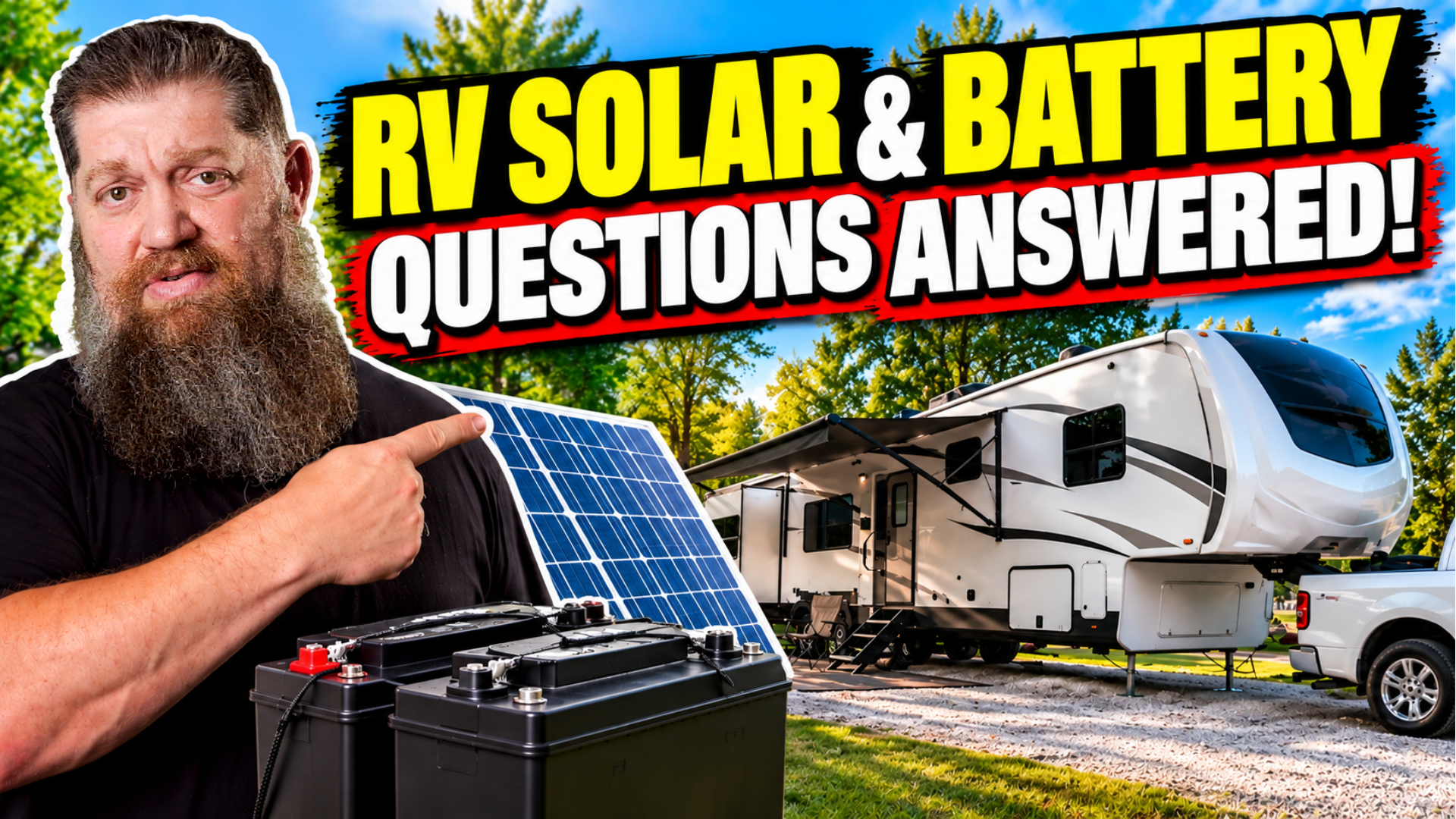
RV solar and battery questions can become complicated quickly, especially when you are dealing with battery storage, solar charging, wire protection, and multiple batteries.
In this Tech Tip Tuesday, Todd answers three questions submitted by viewers. He covers maintaining lead acid batteries during RV storage, choosing a breaker for a 400 watt solar panel, and charging two lithium batteries connected in parallel.
Maintaining RV Batteries During Winter Storage
The first question comes from an RV owner with a Class C motorhome. The RV has solar and a generator, but it will receive limited sunlight during winter storage.
The owner wants to use a portable solar trickle charger to keep the house batteries topped off. Can the charger connect directly to the battery terminals? Or should the owner disconnect the house batteries from the rest of the RV solar system?
An important detail is that these are lead acid batteries.
Todd explains that lead acid batteries should receive some charge during storage. Lithium batteries are different. Todd says you should handle lithium batteries differently when storing them for several months.
Understanding these differences is an important part of learning about RV electrical systems.
What About Parasitic Loads in Your RV?
Even after you turn off equipment inside your RV, some devices can continue drawing power.
Todd specifically mentions the CO detector and LP detector. These small parasitic loads continue pulling power from the battery.
For lead acid batteries, Todd explains that a small charge combined with a small demand can actually help. However, the portable solar system must produce enough energy to keep up with those loads.
You do not necessarily need six hours of full sunlight. Instead, the solar system needs to produce enough energy during the day to overcome the total demand during a 24 hour period.
Can a Solar Charger Connect Directly to the RV Battery?
Todd says you can connect the portable solar charger directly to the lead acid battery terminals. However, the system needs a solar controller designed for lead acid batteries.
The controller manages the power coming from the solar panel before it reaches the battery.
In this situation, Todd says the RV owner is already on the right track.
If you want to better understand how panels, controllers, batteries, and inverters work together, RV solar training can help you understand the complete system.
Can the BIM 160 Help Maintain the Chassis Battery?
The viewer also asks whether the BIM 160 can allow some of the available charge to help keep the chassis battery topped off.
The ignition and boost connections associated with the BIM and explains that using the system introduces another battery into the charging chain.
That means available solar capacity becomes important.
Something in the range of 200 to 400 watts could potentially keep up with the setup he is discussing, while also noting that there will be some loss in the system.
What Size Breaker Should You Use With a 400 Watt Solar Panel?
The second RV solar and battery question involves a 400 watt solar panel and the breaker installed between the panel and MPPT solar controller.
The primary point is simple: the breaker should never be larger than the wire it is protecting.
He discusses two common PV wire sizes. 12 gauge PV wire is rated for 30 amps, and 10 gauge PV wire is rated for 40 amps.
Regardless of the output coming from the solar panel, the goal is to prevent the wire from being overloaded. The breaker should be the weak point in the circuit.
For the single 400 watt panel in the viewer’s example, it would typically produce approximately 11 to 12 amps. He says a 20 amp or 30 amp breaker could provide sufficient clearance while protecting the wire in the situation described.
This is one example of why understanding both solar production and RV electrical troubleshooting is important when working with an RV solar installation.
How Do You Charge Two Lithium Batteries in Parallel?
The final question involves two 300 amp hour lithium batteries connected in parallel.
Can a designated lithium charger be connected to one battery with the goal of charging both?
Todd says yes.
However, when both batteries are accessible, he recommends connecting the charger’s positive lead to the positive post on Battery A and the negative lead to the negative post on Battery B.
This arrangement makes the charging circuit run through both batteries and helps them charge more evenly.
If access makes that connection difficult, the charger can still be connected to one battery. There may be a slight balance difference between the two batteries because of wire resistance and the internal resistance of the batteries.
Understanding Your RV Solar and Battery System
These three RV solar and battery questions involve different situations, but each demonstrates why understanding the entire electrical system matters.
Battery chemistry affects how batteries should be maintained during storage. Parasitic loads affect how much solar charging is required. Wire size affects breaker selection. Battery configuration affects how a charger should be connected.
Understanding how these components interact can make RV electrical systems much less intimidating.
At the National RV Training Academy, students can develop hands-on knowledge of the electrical and solar systems found in today’s RVs. RV Service Technician training provides an opportunity to go beyond individual tips and develop a broader understanding of how RV systems operate and how to troubleshoot them.
Whether you want to better understand your own RV or develop skills for working as an RV technician, learning the fundamentals can give you a stronger foundation for diagnosing electrical and solar problems.



Get Registered Today!
Talk to a student advisor to learn more!