
LEARN and EARN!
Get your RV Technician Certification in as little as 5 weeks!
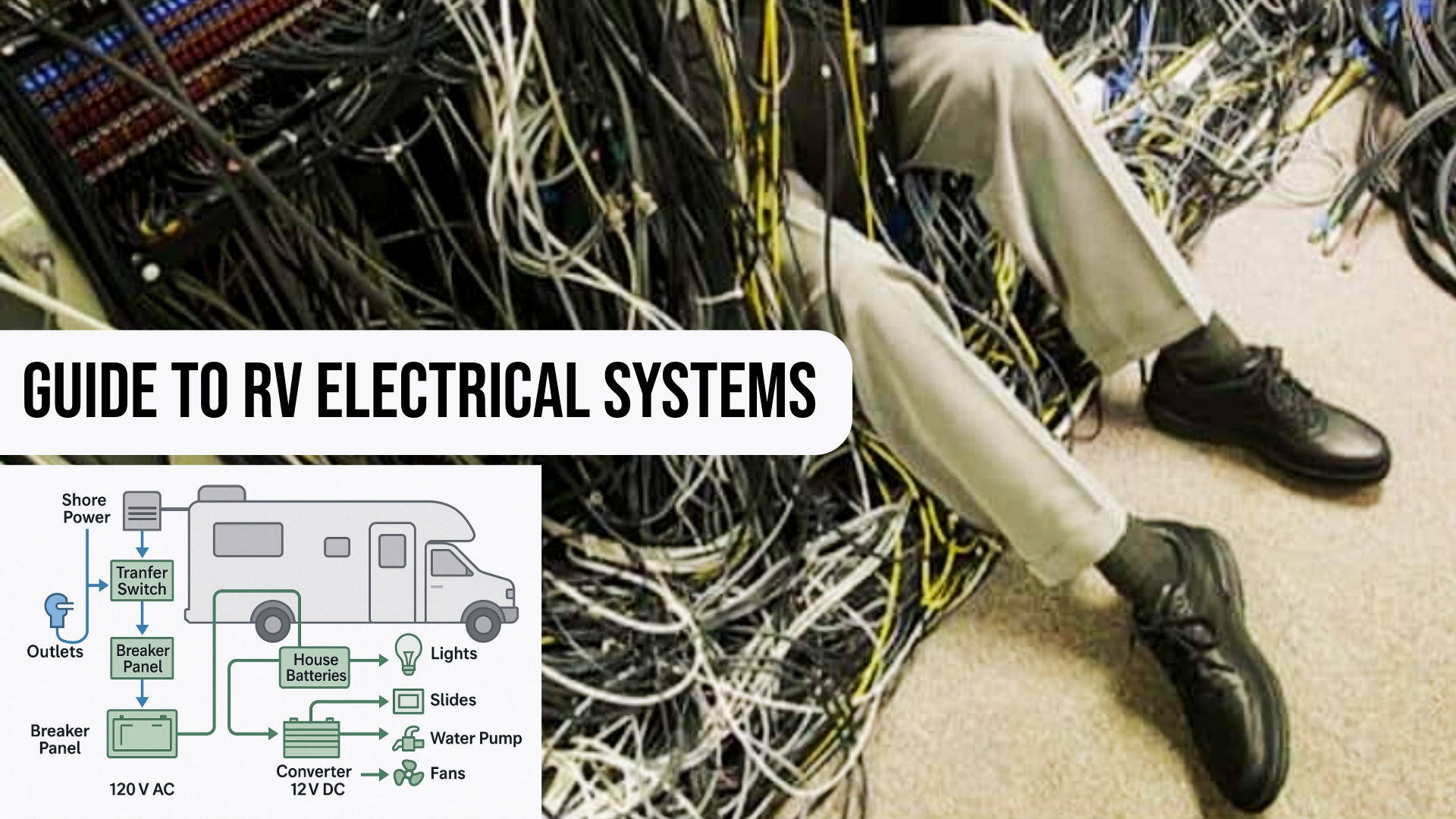
WARNING: Working with RV electrical systems involves both low-voltage (12V DC) and household-level voltage (120V AC). Before inspecting or servicing any electrical components, power should be disconnected from all sources, including shore power, batteries, and generators. If you are unsure about a procedure, it may be best to consult a RVTAA Certified qualified technician.
RV electrical systems combine 120-volt alternating current, 12-volt direct current, batteries and equipment that converts or routes power. Shore power and generators normally supply 120-volt AC. Batteries supply 12-volt DC in most RVs. Meanwhile, converters, inverters, transfer switches and solar charge controllers help those power sources work together.
Understanding that basic structure makes RV electrical troubleshooting much easier. First, identify which source should supply power. Next, determine whether the affected equipment uses AC or DC. Then, trace the power path through the correct protection and distribution components.
RV Electrical Safety Comes First
Warning: RV electrical systems include both nominal 12-volt DC and potentially lethal 120-volt AC. Batteries can also release extremely high current during a short circuit. If you lack the training or equipment to perform a procedure safely, stop and contact an RVTAA Certified RV Service Technician or another qualified professional.
Before opening a panel or servicing electrical equipment, follow the manufacturers’ shutdown and isolation procedures. Depending on the RV, power may come from:
- Shore power
- A generator
- An inverter
- House or chassis batteries
- Solar panels and a charge controller
- An alternator or DC-to-DC charger
- Automatic generator-start or transfer equipment
Turning off one source may not de-energize the entire system. For example, an inverter can energize selected 120-volt circuits after you disconnect shore power. Solar panels can also produce voltage whenever light reaches them. In addition, some equipment can retain stored energy after shutdown.
Do not remove electrical-panel covers, expose live conductors or perform live-voltage testing unless you understand the hazards and have the proper training and equipment. Never rely only on a switch position; use the manufacturer’s procedure to isolate the system and verify its condition.
For a deeper explanation of current paths and safety conductors, read RV electrical grounding explained.
What Is an RV Electrical System?
An RV electrical system uses several connected subsystems rather than one single source of power. A typical RV includes:
- A 120-volt AC system for receptacles and higher-demand appliances
- A nominal 12-volt DC system for lights, controls and other essential equipment
- A house battery bank that stores DC energy
- AC and DC distribution panels
- Overcurrent-protection devices such as circuit breakers and fuses
- Conversion and charging equipment
- Source-selection equipment, such as a transfer switch
Some RVs also include an inverter, solar charging, alternator charging, an onboard generator, an energy-management system or a higher-voltage battery bank with DC-to-DC conversion.
The exact design varies considerably. Therefore, use the diagrams and manuals for the specific RV and installed components whenever you troubleshoot or modify the system.
How RV Electrical Systems Work
When you connect an RV to a compatible campground pedestal, shore power enters through the power cord and normally travels to the main AC distribution panel. Circuit breakers then feed individual 120-volt branch circuits.
Those circuits may power:
- Air conditioners
- A microwave
- Receptacles
- An electric water-heater element
- An electric refrigerator circuit
- A converter or inverter/charger
At the same time, a converter or inverter/charger can use AC power to supply the RV’s DC system and charge the house batteries. However, charging behavior depends on the equipment, battery chemistry, settings, temperature and system design.
When shore power disappears, the batteries continue supplying the DC system. If the RV includes an inverter, the inverter can use battery energy to produce 120-volt AC for the circuits connected to its output. It does not automatically power every receptacle or appliance in the RV.
AC vs. DC Power in an RV
AC and DC describe different forms of electrical power. Knowing which one a device uses helps narrow the troubleshooting path.
What Uses 120-Volt AC Power?
An RV commonly uses 120-volt AC for:
- Air conditioners
- Microwaves
- Standard receptacles
- Electric heating elements
- Residential-style refrigerators
- Battery converters and inverter/chargers
Shore power or a generator normally supplies this energy. An inverter may also supply selected AC circuits when the battery bank and inverter can support the load.
Circuit breakers protect AC branch-circuit wiring from overcurrent. However, a breaker does not provide every form of electrical protection. For example, a ground-fault circuit interrupter helps protect people from certain ground-fault conditions, while an electrical-management system may monitor pedestal voltage, frequency, polarity and other source conditions.
What Uses 12-Volt DC Power?
The 12-volt DC system commonly powers:
- Interior and exterior lights
- The water pump
- Furnace controls and blower
- Vent fans
- Propane-appliance control boards
- Refrigerator controls on many models
- Slide-out and leveling controls or motors
- Safety devices and monitoring equipment
Many RV appliances need 12-volt DC controls even when propane or 120-volt AC provides the appliance’s main energy source. As a result, an appliance may stop working when the RV loses stable DC power even though shore power remains available.
Where Shore Power Enters the System
Campground shore power usually comes through a 30-amp or 50-amp RV connection.
30-Amp RV Service
A standard 30-amp RV connection supplies one 120-volt hot leg:
30 amps × 120 volts = 3,600 watts
That limit requires owners to manage high-demand appliances. For example, an air conditioner, microwave and electric water heater can exceed the available power when they operate together.
50-Amp RV Service
A standard 50-amp RV connection provides two 120-volt hot legs, each rated for up to 50 amps. The service can provide up to:
50 amps × 120 volts × 2 legs = 12,000 watts
Although the pedestal connection uses a 120/240-volt split-phase configuration, most RV branch loads operate at 120 volts from one leg to neutral. RV manufacturers distribute those loads between the two legs.
Therefore, the difference between 30-amp and 50-amp service involves much more than 20 additional amps. Read NRVTA’s complete comparison of 30-amp versus 50-amp RV service.
If a 50-amp RV must use a 30-amp pedestal, an approved adapter can provide a connection, but it cannot create additional power. This guide explains whether you can plug a 50-amp RV into 30-amp power.
How the RV Battery System Works
The house battery bank stores DC energy for use when an external AC source is unavailable. Common RV battery types include:
- Flooded lead-acid
- Absorbed glass mat, or AGM
- Lithium iron phosphate, often called LiFePO4 or LFP
These batteries do not share identical charging, storage, temperature or maintenance requirements. Therefore, the converter, inverter/charger, solar controller and other charging sources must use settings that suit the battery manufacturer’s specifications.
Battery voltage alone does not always show how much usable energy remains. This becomes especially important with lithium batteries because they maintain a relatively flat voltage through much of their discharge. A properly installed RV battery shunt can measure current moving into and out of the bank and calculate state of charge when configured correctly.
Although the battery supports the DC system, some converters can supply nominal 12-volt DC loads without a battery. Nevertheless, slides, leveling systems and other heavy loads may depend on battery support. Always verify the design of the particular RV.
What Does an RV Converter Do?
An RV converter changes 120-volt AC into nominal 12-volt DC. When the RV receives compatible AC power, the converter can:
- Supply DC loads
- Recharge the house batteries
- Support the DC distribution system
Modern converter/chargers may use multiple charging stages or battery-detection features. Even so, the charging profile must match the battery chemistry and manufacturer requirements.
A failed converter can cause low battery voltage, dim lights or a battery that does not recharge. However, those symptoms do not prove that the converter failed. A tripped AC breaker, open DC fuse, battery disconnect, loose connection, incorrect setting or failed battery can create similar symptoms.
What Does an RV Inverter Do?
An inverter changes DC battery power into 120-volt AC power. The inverter draws energy from the battery bank and supplies only the AC circuits that the RV manufacturer or installer connected to it.
For example, a smaller inverter may supply a television and a few receptacles. A larger system may feed an inverter subpanel or more of the coach. Regardless of size, the inverter cannot produce energy; it converts energy that the battery bank supplies and consumes some power during that conversion.
Some RVs use an inverter/charger. This device combines inverter and battery-charging functions and may also provide AC pass-through or power-assist features. Therefore, its behavior changes with the model, settings, wiring and available power source.
If some receptacles work on shore power but stop working while boondocking, the RV may operate normally. Learn why not all RV outlets work from an inverter.
RV Fuse Panel vs. Breaker Panel
Most RVs have separate protection for AC and DC branch circuits.
AC Circuit Breakers
Circuit breakers protect 120-volt branch wiring from excessive current. If a breaker trips:
- Turn off or unplug the loads on that circuit.
- Investigate obvious overloads or equipment problems.
- Follow the RV or component manufacturer’s reset procedure.
Do not repeatedly reset a breaker that trips again. A recurring trip can indicate an overload, short circuit, ground fault, loose connection or failed appliance.
DC Fuses
Fuses protect 12-volt DC branch wiring from overcurrent. If a fuse opens, replace it only with the same type and rating that the manufacturer specifies.
Never install a larger fuse to keep it from opening. The fuse protects the wiring, so oversizing it can allow the wiring to overheat before the fuse responds. If the replacement opens again, stop and find the cause.
Common RV Electrical Problems
An organized diagnosis begins with the symptom and the type of power the affected equipment needs.
RV Lights or Water Pump Do Not Work
These loads normally use 12-volt DC. Possible causes include:
- Low battery voltage
- An open fuse
- A battery-disconnect problem
- A poor connection or ground
- Loss of converter output
Start by determining whether one circuit failed or the entire DC system lost power.
RV Outlets Do Not Work
Receptacles normally use 120-volt AC. Check whether:
- The RV has a valid shore-power or generator source
- The main or branch breaker opened
- A GFCI receptacle tripped
- The affected outlet belongs to an inverter-fed circuit
- A transfer switch or inverter pass-through issue affects the circuit
Turn off loads before resetting a breaker or GFCI. If it trips again, stop and investigate the cause.
The RV Battery Does Not Charge
Possible causes include:
- No AC input to the converter or inverter/charger
- An open converter breaker or charging fuse
- A battery disconnect in the wrong position
- Loose or damaged connections
- Incorrect charger settings
- A failed charger, battery or monitoring component
Measure voltage only when you understand the correct test points, meter settings and safety precautions. One voltage reading rarely identifies the failed component by itself.
Appliances Work on One Source but Not Another
This symptom often points to the source-selection or conversion path. For example, an appliance may work on shore power but not from an inverter because the inverter does not feed that circuit. Likewise, a generator problem may involve its breaker, transfer switch, output or control system.
A Safer RV Electrical Troubleshooting Process
Use a logical sequence rather than replacing parts based on symptoms alone.
1. Define the Symptom
Identify exactly what stopped working. Determine whether the problem affects one device, one circuit, all AC loads, all DC loads or only one power source.
2. Identify the Required Power
Check whether the device needs 120-volt AC, 12-volt DC, propane with 12-volt controls or more than one source.
3. Confirm the Selected Source
Verify the operating mode and source without opening energized equipment. For shore power, a properly rated plug-in tester or electrical-management system can provide useful information. Never open or service a campground pedestal.
4. Check User-Accessible Protection
With loads turned off, inspect the user-accessible breakers, fuses and GFCIs. Replace a fuse only with the correct type and rating. Do not repeatedly reset a device that opens again.
5. Review Disconnects and Settings
Confirm battery-disconnect positions, inverter modes, charger profiles and generator breakers. Also check whether an energy-management system has intentionally shed a load.
6. Stop Before the Procedure Exceeds Your Training
Live AC testing, panel removal, transfer-switch diagnosis and high-current battery work can create shock, arc, fire and equipment hazards. At that point, contact a qualified technician.
Load Management in an RV
An RV has less available electrical capacity than a typical house. Therefore, owners need to consider which appliances operate at the same time.
High-demand loads may include:
- Air conditioners
- Electric water heaters
- Microwaves
- Electric fireplaces
- Hair dryers
- Space heaters
- Residential refrigerators
- Battery chargers operating at high output
Watts equal volts multiplied by amps:
Watts = volts × amps
That formula helps estimate whether a combination of loads may exceed the available source. However, motor-driven equipment can draw additional current during startup, and appliance labels or manuals provide better information than a generic estimate.
Some newer RVs include an energy-management system that automatically sheds selected loads. Inverter/chargers with power-assist features may also supplement a limited AC source with battery power. Nevertheless, the system still has limits based on the shore connection, inverter, batteries, wiring and configuration.
Where Solar Fits Into an RV Electrical System
Solar panels generate DC electricity, but their output voltage varies with panel design, sunlight, temperature and system configuration. A solar charge controller manages that panel output and applies an appropriate charging profile to the battery bank.
A typical system includes:
- Solar panels
- PV wiring and required protection or disconnects
- A solar charge controller
- A battery bank
- A battery monitor
- An inverter when the owner needs 120-volt AC away from shore power
Solar output does not guarantee that the batteries will remain full. Daily production must exceed or adequately offset daily consumption, charging losses and other demands. If that balance falls short, the batteries lose state of charge over time. NRVTA explains why RV batteries can be dead even with solar.
People who want advanced hands-on instruction in system design, batteries, controllers and inverters can explore RV Solar Technician Training.
Where a Generator Fits Into the System
An onboard or portable generator can supply 120-volt AC when shore power remains unavailable. Depending on its size and the RV’s configuration, it may power AC appliances while a converter or inverter/charger supplies DC loads and recharges the batteries.
The generator cannot support unlimited demand. Its rated output, fuel supply, altitude, temperature, maintenance condition and connected loads all affect performance.
Generators also introduce exhaust, carbon-monoxide, fuel and grounding considerations. Always follow the generator and RV manufacturers’ operating instructions. For advanced hands-on instruction, visit RV Generator Technician Training.
Why Understanding RV Electrical Systems Matters
RV electrical systems connect multiple sources, conversion devices, protection components and loads. Consequently, a problem in one area can create symptoms somewhere else.
For an RV owner, understanding the power path helps separate a simple user-accessible issue from a condition that requires professional service. It also helps owners manage loads and communicate more clearly with a technician.
NRVTA’s RV Owner Training introduces owners to essential RV systems and basic troubleshooting. People who want to develop advanced diagnostic and repair skills for a service career can explore RV Service Technician Training.
The National RV Training Academy provides hands-on training for RV owners and people pursuing technician or inspection pathways. A student advisor can explain the course content, schedules and training options without promising a particular employment or income outcome.
Does an RV use AC or DC power?
Most RVs use both. Shore power and generators normally supply 120-volt AC, while the battery bank supplies nominal 12-volt DC. Converters and inverters help the two systems work together.
Will an RV converter charge the battery?
A converter/charger can charge the house battery when it receives compatible AC power. However, the charging profile and settings must suit the battery chemistry and manufacturer specifications.
Why do some RV outlets stop working when I unplug from shore power?
Only outlets connected to the inverter receive AC power from the battery bank. Some inverters feed one appliance or a few outlets, while larger systems may feed an inverter subpanel.
What is the difference between 30-amp and 50-amp RV service?
A 30-amp RV connection supplies up to approximately 3,600 watts at 120 volts. A standard 50-amp RV connection supplies two 120-volt, 50-amp legs for up to approximately 12,000 watts total.
Can I replace a blown RV fuse with a larger fuse?
No. Use the same fuse type and rating that the manufacturer specifies. A larger fuse may allow the wiring to overheat before the fuse opens.
Should I keep resetting an RV breaker that trips?
No. Turn off the connected loads and investigate the cause. If the breaker trips again, stop resetting it and contact a qualified technician.


Get Registered Today!
Talk to a student advisor to learn more!